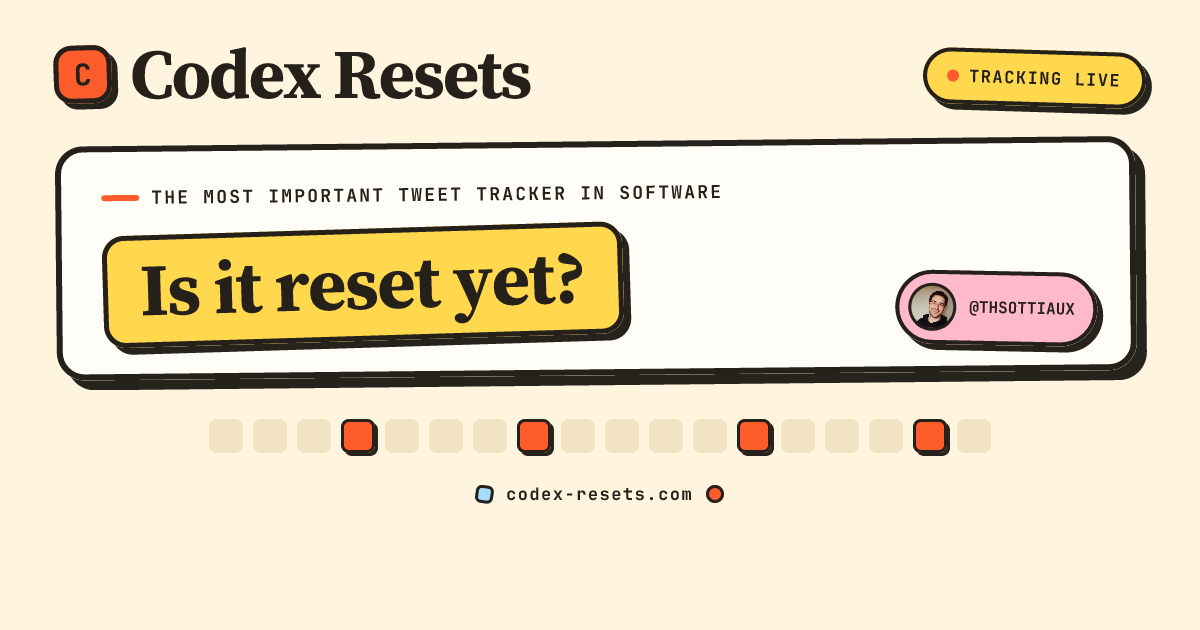
A dedicated community website has documented 46 usage limit resets for OpenAI's Codex coding assistant over the past six months, revealing the company's approach to managing capacity constraints during rapid growth.
Codex Resets, an independent tracker, monitors announcements from OpenAI's Thomas Sottiaux on X to log when the company refreshes weekly usage limits for paid subscribers. The data shows resets occurring every 7.6 days on average, with the longest gap reaching 67.7 days.
The reset frequency accelerated dramatically in July 2026, coinciding with OpenAI's launch of GPT-5.6 Sol and rapid user growth. Sottiaux announced reaching 20 million active Codex users in August, up from 15 million earlier that month.
Why the frequent resets matter
The pattern suggests OpenAI is using manual interventions to balance user experience against infrastructure constraints. Recent announcements cite "faster than expected" usage consumption and capacity optimization issues.
Sottiaux's messages reveal technical challenges behind the scenes. A July reset followed reports that Sol was "using your Codex limits faster than expected," while another cited cache hit rate problems from a rolled-back optimization.
The company has introduced "banked resets" — additional limit refreshes users can apply manually — as a buffer mechanism. These appear during milestone celebrations or after service incidents.
"We have never seen traffic increase so quickly," Sottiaux wrote in a July announcement, describing the team's efforts to maintain system reliability during the scaling phase.
The tracker shows OpenAI bundling Codex resets with ChatGPT Work, its enterprise offering, suggesting shared infrastructure between the products. Recent updates removed the five-hour rate limit, allowing more intensive usage sessions.
OpenAI's approach contrasts with competitors like Anthropic's Claude, which uses different rate limiting strategies. The frequent manual interventions indicate the company is prioritizing user access over automated capacity management as it scales toward broader availability.
💬 Discussion
Sign in to join the discussion.
Sign in →No comments yet — be the first.