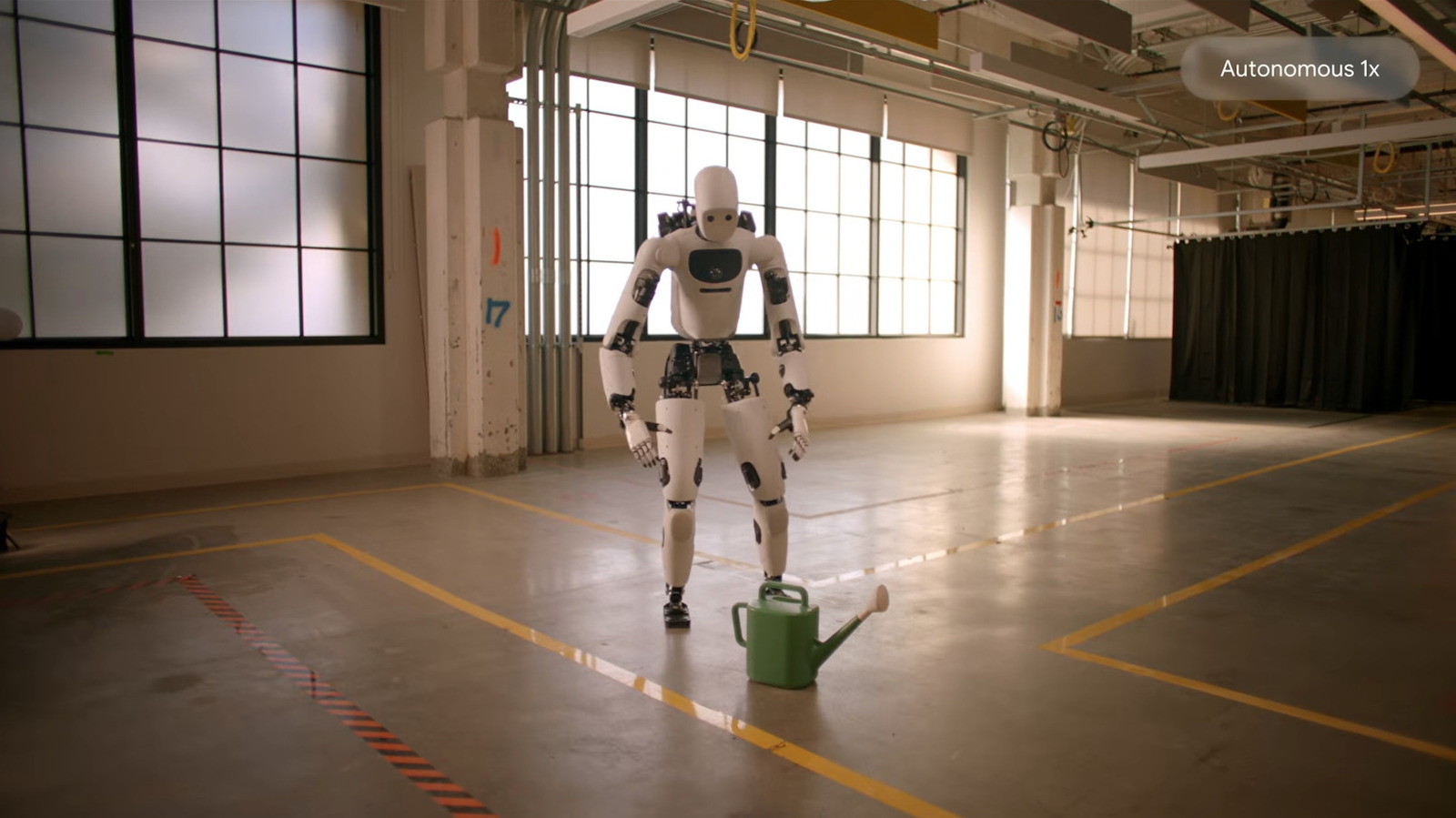
Google DeepMind launched Gemini Robotics 2, an AI platform that gives humanoid robots intelligent whole-body control for complex physical tasks.
The system represents a significant upgrade from the original Gemini Robotics, which was limited to robotic arms and hands. The new platform enables full-body movement coordination for tasks like cleaning trash, screwing in lightbulbs, and tying garbage bags.
Google released demonstration footage showing the robots operating autonomously in real-time. The company emphasized this contrasts with Tesla's Optimus demonstrations, which were later revealed to use human teleoperators for control.
Multi-model architecture powers movement
The platform combines several AI models to create multimodal environmental understanding. A vision language model handles scene comprehension, while two vision language action models control full-body movement and hand manipulation separately.
The robots aren't general-purpose devices yet. Google trained the system specifically for each demonstrated task using human teleoperation, video examples, and simulations.
"It's another milestone in our path towards really getting towards what we call like physical AGI, which means we get a robot to do anything that a human can," Google DeepMind stated.
Safety remains a critical concern given AI's propensity for errors. Carolina Parada, head of robotics at Google DeepMind, acknowledged the heightened safety requirements when deploying AI in physical robot bodies.
Google implemented multi-layered safety guardrails across each model component. The company also introduced ASIMOV-Agentic, a new benchmark for detecting whether commands might lead to harmful outcomes.
"There's a lot of uncertainty that will show up, and so you want to be able to understand the safety question more deeply," Parada told Wired.
The technology remains in early development stages. Google hasn't announced consumer availability timelines, positioning this as research progress rather than a commercial product launch.
Tesla CEO Elon Musk previously promised 50,000 to 100,000 Optimus robots by 2026 and claimed the product could generate $10 trillion in sales. Those projections appear increasingly unrealistic as deadlines approach.
💬 Discussion
Sign in to join the discussion.
Sign in →No comments yet — be the first.