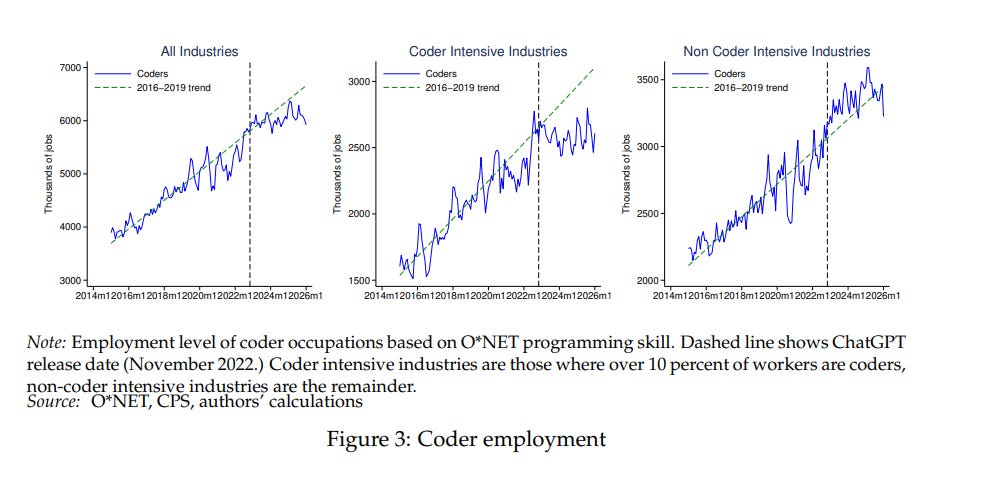
Programming job growth in the United States dropped by roughly 50% after ChatGPT launched in November 2022, according to a new Federal Reserve study.
Fed economists Leland D. Crane and Paul E. Soto found that programming-intensive jobs had been growing at around 5% annually before ChatGPT's release — well above the overall labor market rate. The decline represents the first concrete federal data linking AI deployment to measurable employment effects in tech.
The findings come as public sentiment toward AI continues to sour across demographic lines. Half of Americans now express more concern than excitement about AI use, according to Pew Research, while Gen Z excitement sits at just 22%, per Gallup data.
Growing AI skepticism among young workers
The disconnect between Silicon Valley optimism and public opinion appears particularly pronounced among younger Americans entering the job market. The same demographic facing reduced programming opportunities shows the lowest enthusiasm for AI technology.
Gen Z workers are experiencing what researchers call an "AI paradox" — exposure to AI tools in education and early careers, but diminishing confidence in the technology's benefits for their economic prospects.
The Fed study tracked employment patterns across programming-intensive occupations, including software development, data analysis, and systems administration. The 50% decline in growth rates suggests AI coding assistants like GitHub Copilot and competitors may be reducing demand for entry-level programming roles.
"The more exposed we are to an Internet of AI slop and even the potential of career ladder disruption, the less happy young people are starting to be," noted AI researcher Michael Spencer in his analysis of the data.
The employment effects coincide with broader economic pressures. Inflation concerns have returned following geopolitical tensions, while venture funding for AI startups remains concentrated among established players rather than job-creating early-stage companies.
The Fed researchers plan to expand their analysis to other AI-exposed occupations, including technical writing, customer service, and content creation roles. Initial data suggests similar patterns may be emerging across knowledge work sectors where AI tools have gained adoption.
💬 Discussion
Sign in to join the discussion.
Sign in →No comments yet — be the first.