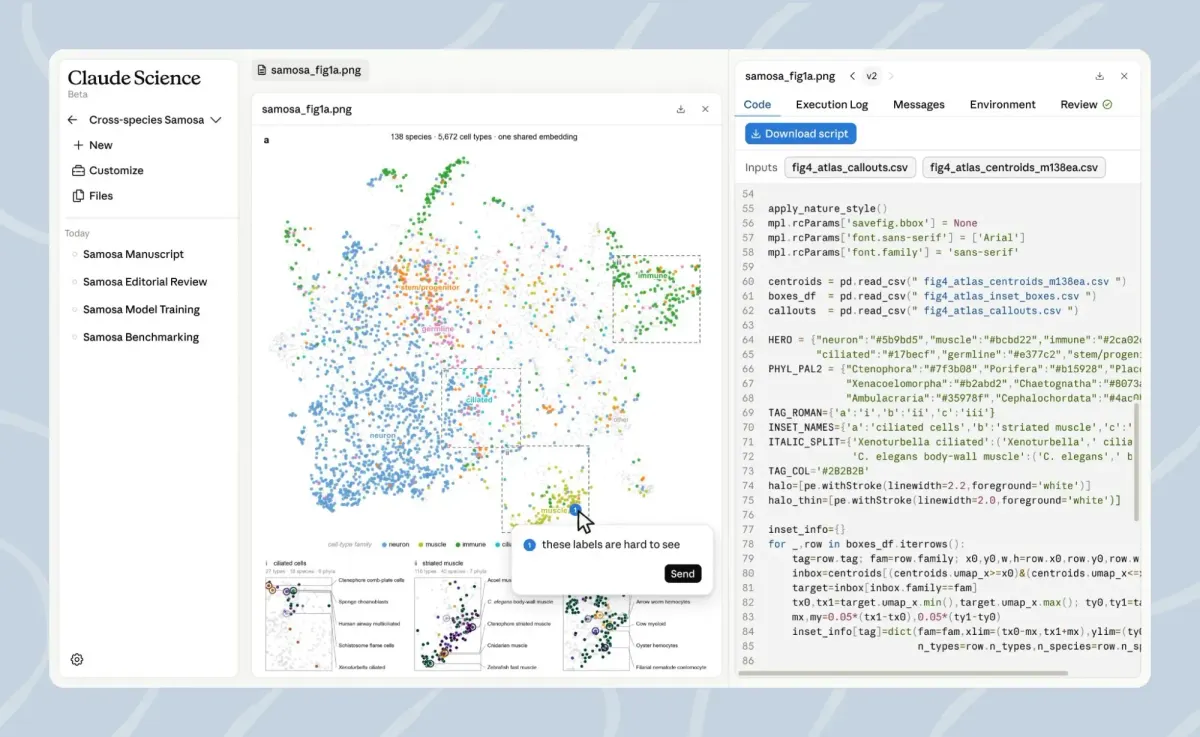
Anthropic launched Claude Science, an AI-powered research workbench targeting life sciences researchers with over 60 specialized tools for genomics, proteomics, and cheminformatics.
The platform runs on macOS and Linux systems, supporting local machines, remote clusters, and SSH connections. It integrates with existing high-performance computing infrastructure for academic institutions and research labs.
View tweet from @claudeai
Claude Science is available in beta for users on Claude Pro, Max, Team, and Enterprise plans. Research groups can apply for discounted Team rates, with applications for dedicated AI for Science project credits open until July 15, 2026.
What Claude Science offers researchers
The workbench manages complex analyses and handles computing job submissions while ensuring reproducibility. Every artifact includes attached code, environment details, and plain-language descriptions for transparency.
Built-in reviewer agents automatically catch citation errors and calculation mistakes. Researchers can customize workflows or integrate proprietary lab tools as needed.
Early adopters have used the system for CRISPR screen design and multi-agent literature review. Users report significant reductions in analysis time and improved data validation compared to traditional methods.
The platform connects to scientific databases spanning structural biology and cheminformatics. It supports both individual researchers and collaborative team workflows across different computing environments.
Anthropic continues gathering feedback from research teams to expand platform capabilities. The company aims to accelerate scientific discovery through improved AI tooling for laboratory workflows.
💬 Discussion
Sign in to join the discussion.
Sign in →No comments yet — be the first.