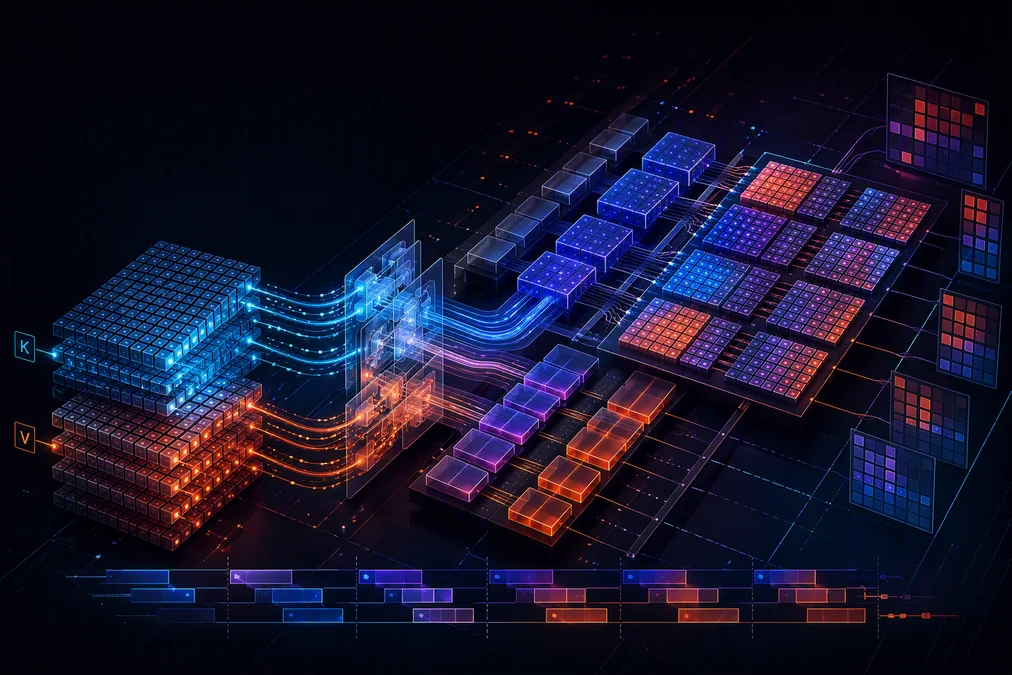
AMD has published technical specifications for its MI450 GPU series, revealing hardware designed specifically for memory-intensive AI workloads that emerge from agentic applications requiring million-token context windows.
The MI450 represents a significant leap from the MI350 series. HBM bandwidth jumps from 8.1 TB/s to 19.6 TB/s, while memory capacity increases from 288 GB to 432 GB. On-chip resources also expand substantially, with vector registers doubling from 512 to 1,024 per SIMD unit and local data share memory growing from 160 KB to 320 KB per workgroup processor.
Specialized tensor hardware
The most notable addition is the Tensor Data Movement (TDM) unit, which handles bulk data transfers between global memory and local storage. Unlike previous generations that required many small vector loads, TDM allows kernels to describe target tensors using memory addresses, shapes, strides, and layouts, then execute asynchronous bulk transfers.
AMD engineers demonstrated the architecture's capabilities using attention decode as a case study. In long-context inference scenarios, each new token must attend to all previous tokens from the KV cache, creating a memory bottleneck as kernels repeatedly read past states from HBM.
The MI450 also introduces workgroup clusters, allowing multiple workgroups running on separate processors to coordinate through hardware-supported barriers. This enables multicast loads where workgroups accessing identical data can share information across processors without separate kernel launches.
Performance results
Using the Gluon programming framework, AMD's optimized attention decode kernel achieved 85% of peak HBM bandwidth on MI450 hardware. The company positioned this as an early result, suggesting further optimizations remain possible.
The technical disclosure comes as AI inference workloads increasingly shift toward agentic applications that process extensive context windows. Modern LLM requests can reach one million tokens from aggregated prompts, tool calls, retrieval results, and multi-turn reasoning chains.
AMD has not announced commercial availability dates for the MI450 series or provided pricing information.
💬 Discussion
Sign in to join the discussion.
Sign in →No comments yet — be the first.