
Samsung Bets Big on AI to Fuel Chip Demand in 2026
The memory giant's executives project sustained demand through 2027 as HBM4 enters mass production for NVIDIA's Vera Rubin platform.

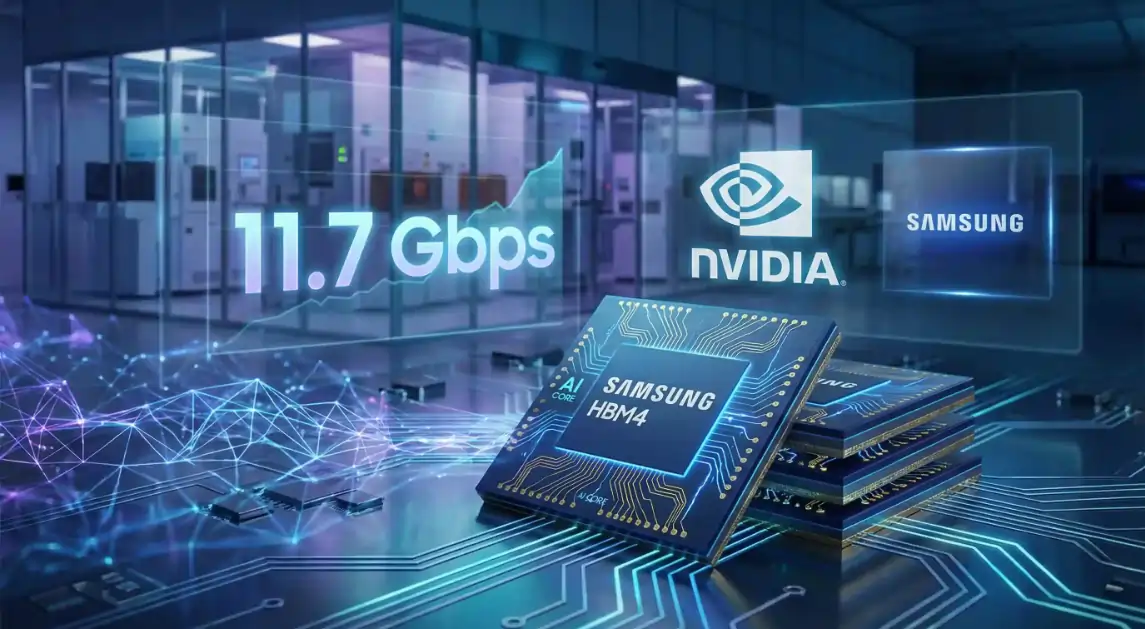
Samsung Electronics is doubling down on its AI chip ambitions, with senior executives telling Reuters that artificial intelligence will sustain strong semiconductor demand throughout 2026 and well into 2027. The announcement arrives as the South Korean tech giant showcases its sixth-generation HBM4 and the next-generation HBM4E at NVIDIA GTC 2026 in San Jose this week.
HBM4 Hits Mass Production at a Critical Moment
Samsung confirmed on March 17 that its HBM4 memory chips are now in mass production, designed specifically for NVIDIA's Vera Rubin AI accelerator platform. The chips deliver consistent processing speeds of 11.7 gigabits per second, exceeding the industry standard of 8 Gbps, with the ability to scale to 13 Gbps.
The company also displayed its HBM4E for the first time, promising 16 Gbps per pin and a total bandwidth of 4.0 terabytes per second. Both chips are built on Samsung's most advanced sixth-generation 10-nanometer-class DRAM process, known as 1c, which has achieved stable yields.
This matters because Samsung had spent much of 2025 playing catch-up. SK Hynix overtook it in overall DRAM market revenue for the first time in Q1 2025, capturing 36% global share compared to Samsung's 34%, according to Counterpoint Research. Getting HBM4 to mass production and into NVIDIA's supply chain was the single most important thing Samsung could do to reclaim lost ground.
A Profit Machine Running on AI Demand
The financial numbers tell the story. Samsung's semiconductor division posted a record operating profit in Q4 2025, surging 470% year over year to 16 trillion won. The company projected that its overall HBM revenue would more than triple in 2026, having secured orders for the entirety of its HBM capacity for the year.
“The ongoing AI boom is anticipated to sustain favorable market conditions across the industry” in Q1 2026, Samsung said in its January earnings statement. Memory executive Kim Jaejune warned analysts that “a significant shortage of memory products across the board is expected to continue for the time being,” with limited supply expansion through 2027.
The global DRAM market is expected to more than double to $311 billion in 2026, nearly six times the market's trough, according to analyst estimates. Memory prices surged 40% to 50% in Q4 2025 alone, with similar gains forecast for the opening months of this year.
NVIDIA, Tesla, and OpenAI All Want Samsung Chips
Samsung's customer list reads like a who's who of the AI industry. NVIDIA is the primary recipient of its HBM4 production, with the chips powering the upcoming Vera Rubin accelerators. Tesla signed a $16.5 billion deal with Samsung in July 2025 to manufacture its next-generation AI6 chip at Samsung's Texas fab. And OpenAI struck a separate agreement with Samsung to source DRAM wafers for its Stargate AI infrastructure project.
At GTC 2026, Samsung is also exhibiting its SOCAMM2 server memory module, now in mass production, and the PM1763 SSD built on the PCIe 6.0 interface for next-generation AI storage. The breadth of this lineup underscores Samsung's positioning as the only semiconductor company offering a total AI solution across memory, logic, foundry, and advanced packaging.
The Shortage That Won't Quit
The AI chip boom is creating pain elsewhere. Samsung's own mobile phone division saw profit fall to 1.9 trillion won in Q4 2025 as soaring chip prices squeezed margins. Co-CEO TM Roh described the shortage as “unprecedented” and hinted that price hikes for consumer devices could follow.
IDC has warned that the smartphone market faces its biggest-ever decline in 2026 as memory price inflation ripples through the supply chain. NAND flash wafer contract prices jumped over 60% in November 2025, while GDDR6 prices inflated roughly 30% as manufacturers pivoted to GDDR7 for AI GPUs.
NVIDIA CEO Jensen Huang captured the mood at CES earlier this year. “The world is going to need more fabs, and the reason for that is because of this new industry called AI factories,” he said. “It's good to be a semiconductor manufacturer”.
Samsung and NVIDIA Forge Deeper Manufacturing Ties
Beyond chips, Samsung revealed a strategic collaboration with NVIDIA on AI Factory development, using NVIDIA accelerated computing and Omniverse digital twins to reshape semiconductor manufacturing. Yong Ho Song, Samsung's Executive Vice President and Head of AI Center, presented the partnership details at a GTC session titled around transforming semiconductor manufacturing with agentic AI.
This factory-level integration is significant. Samsung is applying AI not just to the products it sells but to how it builds them, potentially accelerating yield improvements and shortening time to market for future HBM generations.
FAQs
What is Samsung's HBM4 chip and who is it for?
Samsung's HBM4 is its sixth-generation high-bandwidth memory chip, now in mass production as of March 2026. It is designed primarily for NVIDIA's Vera Rubin AI accelerator platform and delivers 11.7 Gbps processing speeds, exceeding the 8 Gbps industry standard.
How much will Samsung's HBM revenue grow in 2026?
Samsung expects its overall HBM revenue to more than triple in 2026 compared to 2025. The company has secured orders for all of its HBM capacity for the year.
Is there still a memory chip shortage in 2026?
Yes. Samsung executive Kim Jaejune confirmed that a significant shortage of memory products is expected to continue, with limited supply expansion through 2026 and 2027.
How does Samsung compare to SK Hynix in the memory market?
SK Hynix overtook Samsung in overall DRAM market revenue in Q1 2025, capturing 36% global share versus Samsung's 34%. Samsung's HBM4 mass production is aimed at closing this gap.
What is Samsung's HBM4E?
HBM4E is Samsung's next-generation successor to HBM4, displayed publicly for the first time at GTC 2026. It delivers 16 Gbps per pin and 4.0 TB/s bandwidth, and uses hybrid copper bonding technology to stack 16 or more layers.
Which major companies have signed chip deals with Samsung?
Tesla signed a $16.5 billion deal for AI6 chips, OpenAI partnered with Samsung for Stargate DRAM wafers, and NVIDIA is the primary customer for HBM4 production.
Sources
Topics
Samsung Electronics
HBM4
NVIDIA GTC 2026
AI Chips
Semiconductor
SK Hynix
AI Infrastructure
Vera Rubin





Samsung AI Chip Demand
HBM4 Speed
11.7 Gbps
HBM4E Bandwidth
4.0 TB/s
Q4 2025 Chip
Profit Growth
470% year over year
2026 HBM
Revenue Target
Triple over 2025
Global DRAM
Market 2026
$311 billion projected
HBM4 Primary
Customer
NVIDIA Vera Rubin
✉️ Daily AI Digest
Get the day's most important AI stories in one sharp email. Join 42,800+ readers.
Free forever · No spam
🔥 Trending Now