
Nvidia Unveils New AI Chips at GTC Megaconference
Jensen Huang projects a $1 trillion AI chip revenue opportunity and bets the company's future on inference computing.

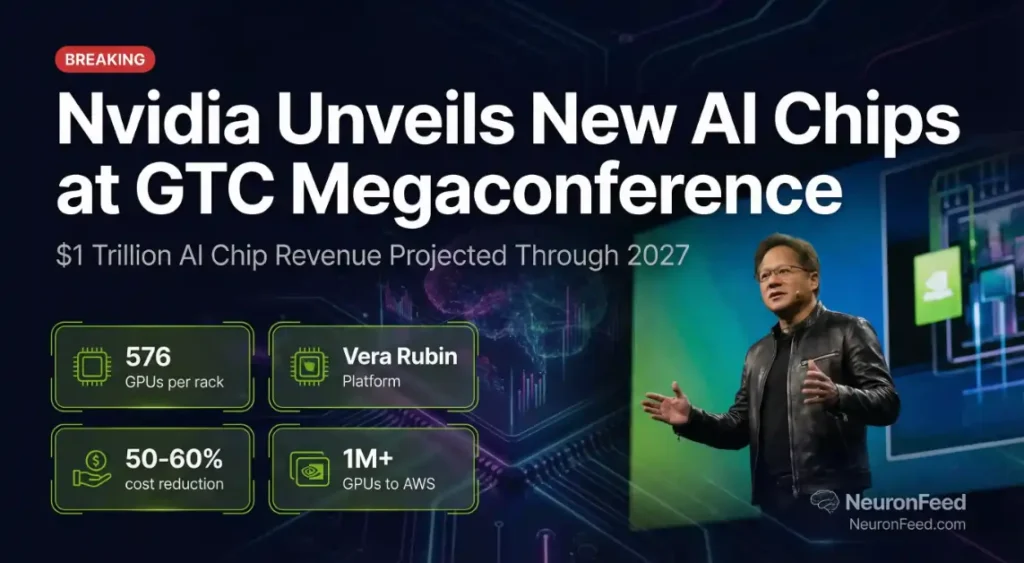
Nvidia just raised the stakes in the AI chip race. CEO Jensen Huang took the stage at the SAP Center in San Jose on Monday, March 16, at the company's annual GTC developer conference and projected at least $1 trillion in AI chip revenue through 2027. That figure doubles the $500 billion opportunity Nvidia had cited on its February earnings call for Blackwell and Rubin chips through 2026.
Dressed in his trademark black leather jacket, Huang addressed more than 18,000 people at the four-day event that has grown into one of the world's largest AI technology showcases. “The inference inflection has arrived,” Huang told the crowd. “And demand just keeps on going up”.
Vera Rubin Takes Center Stage
The biggest hardware announcement was NVIDIA Vera Rubin, a new full-stack computing platform built for agentic AI. The system comprises seven chips, five rack-scale systems and one supercomputer designed as a single vertically integrated unit.
Vera Rubin pairs a custom ARM-based CPU, simply called Vera, with the Rubin GPU on a single package. This eliminates the PCIe bottleneck that slows CPU-to-GPU data transfer in current Blackwell systems and makes NVL576 configurations with 576 GPUs per rack possible, a massive jump from today's NVL72 maximum.
“When we think Vera Rubin, we think the entire system, vertically integrated, complete with software, extended end to end, optimized as one giant system,” Huang said. The platform also includes BlueField-4 STX storage architecture and is expected to cut inference costs by 50 to 60 percent by 2027.
The Groq Factor and the Inference Bet
Huang revealed a new AI inference system built on technology from Groq, a chip startup from which Nvidia licensed technology for $17 billion in December. The strategy splits inference into two distinct steps. Vera Rubin chips will handle “prefill,” converting human language into the tokens AI systems process. Groq's chips will handle “decode,” the step where the AI generates its response.
The move signals Nvidia's intent to dominate not just AI training, where it already commands an estimated 80 percent market share, but also inference, where competition from custom chips built by Google, Amazon and others is growing fast. Huang also introduced the standalone Vera CPU as a new product line, calling it “already for sure going to be a multi-billion-dollar business”.
Feynman and the Three-Generation Roadmap
Looking further ahead, Huang laid out a three-generation GPU roadmap stretching to 2028. After Vera Rubin comes Vera Ultra in the second half of 2027, followed by the Feynman architecture in 2028.
Feynman will feature a new CPU called Rosa, named for Rosalind Franklin, paired with LP40, Nvidia's next-generation LPU, along with BlueField-5 and CX10 networking chips connected through NVIDIA Kyber. The architecture advances every pillar of the AI factory, from compute and memory to storage, networking and security.
Emarketer analyst Jacob Bourne noted that “Huang mapping out a $1 trillion opportunity through 2027 underscores the durable demand for Nvidia's AI infrastructure despite investor concerns”.
NemoClaw Opens the Door for Enterprise AI Agents
On the software side, Nvidia launched NemoClaw, an open source platform for building and deploying autonomous AI agents. The platform integrates with the viral OpenClaw project, which Huang called “the most popular open source project in the history of humanity,” adding enterprise-grade privacy, safety controls and policy enforcement.
“Every single company in the world today has to have an OpenClaw strategy,” Huang said. NemoClaw includes the NVIDIA OpenShell runtime for secure agent execution and pairs with Nemotron models to let developers stand up always-on AI assistants with a single command.
AWS Partnership and AI Factory Scale
In a separate announcement, AWS committed to deploying more than 1 million NVIDIA GPUs, spanning Blackwell, Rubin and Groq 3 LPU architectures, beginning this year across its global cloud regions. Microsoft also confirmed it was the first hyperscale provider to power up the new Vera Rubin NVL72 systems, with global rollout planned over the coming months.
Technalysis Research president Bob O'Donnell summed up the shift in Nvidia's approach. “He used to come out with a new GPU chip and say, look, here's my new chip. Now he's got five racks of equipment that make up these systems”.
From Olaf to Orbit
Huang closed with a surprise appearance by Olaf from Disney's Frozen, powered entirely by Nvidia's physical AI stack, Newton physics engine and Omniverse simulation. The demo illustrated how simulation and physical AI have progressed from concept to real-time execution.
In one of the more unexpected reveals, Huang announced NVIDIA Space-1 Vera Rubin, a system designed to bring AI data centers into orbit. It was a fitting cap for a keynote that stretched from enterprise agents to the cosmos, all anchored by a company determined to own every layer of the AI stack.
Shares of Nvidia briefly jumped on the $1 trillion forecast but pared gains to close up 1.2 percent.
FAQs
What new chips did Nvidia announce at GTC 2026?
Nvidia announced the Vera Rubin full-stack computing platform, featuring seven chips including the Vera CPU and Rubin GPU on a single package. The company also revealed an inference system built on Groq technology licensed for $17 billion, and previewed the Feynman architecture expected in 2028.
What is Nvidia's $1 trillion revenue forecast based on?
The $1 trillion figure represents Nvidia's projected AI chip revenue opportunity through 2027. It is up from a $500 billion estimate through 2026 cited during the February earnings call. The growth is driven by expanding demand across both AI training and inference workloads.
What is NemoClaw and how does it work?
NemoClaw is an open source platform for building and deploying enterprise AI agents. It integrates with the OpenClaw project, adding the NVIDIA OpenShell runtime for secure execution. Developers can use it to stand up autonomous AI assistants with policy enforcement and privacy controls.
How does Nvidia plan to compete in the AI inference market?
Nvidia is splitting inference into two stages. Vera Rubin handles “prefill” by converting text to tokens, while Groq-based chips handle “decode” by generating responses. This two-chip strategy is designed to beat custom silicon from Google, Amazon and other competitors.
What is the Feynman architecture?
Feynman is Nvidia's GPU architecture planned for 2028. It features the Rosa CPU named after Rosalind Franklin, the LP40 next-generation LPU and BlueField-5 networking. It follows Vera Rubin and Vera Ultra in the company's three-generation roadmap.
When will Vera Rubin systems be available?
Microsoft Azure has already powered up the first Vera Rubin NVL72 systems, with global cloud rollout planned over the coming months. AWS will also deploy Rubin-based infrastructure as part of its commitment to host more than 1 million NVIDIA GPUs.
Sources
Topics
Nvidia GTC 2026
AI Chips
Vera Rubin GPU
Jensen Huang Keynote
AI Inference
NemoClaw AI Agents
Feynman Architecture
Enterprise AI



GTC 2026 Snapshots
What Was Revealed
Key Detail
Vera Rubin Platform
7 chips, NVL576 racks
Groq Inference System
$17B
licensed technology
Feynman Roadmap
Expected 2028 launch
NemoClaw Platform
Open source AI agents
Revenue Forecast
$1T through 2027
AWS GPU Deployment
1M+ NVIDIA GPUs
✉️ Daily AI Digest
Get the day's most important AI stories in one sharp email. Join 42,800+ readers.
Free forever · No spam
🔥 Trending Now