
Altman Exits Helion Board as OpenAI Eyes Fusion Deal
A 50-gigawatt power agreement could reshape how AI companies fuel their data centers forever.

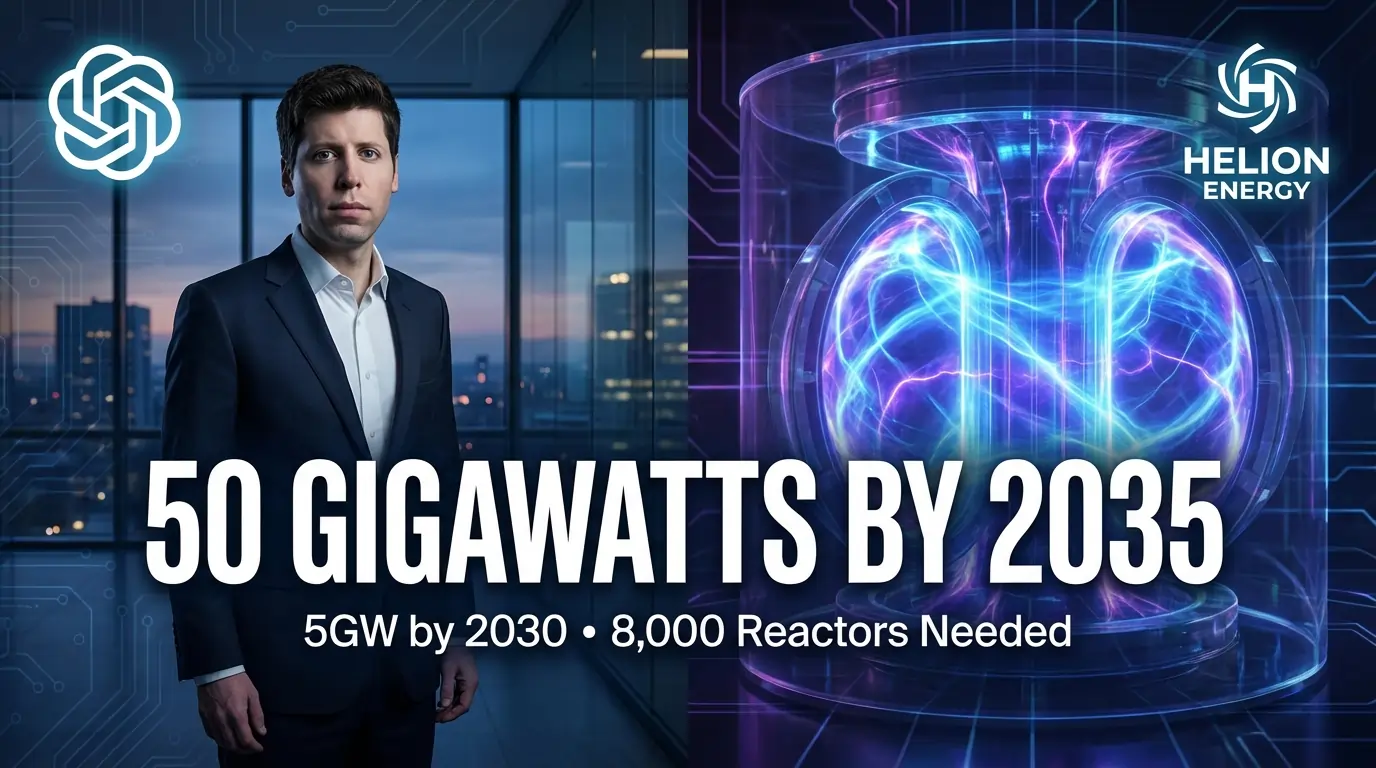
Sam Altman just quit the board of the fusion startup he has backed for more than a decade. The reason is simple and enormous. OpenAI and Helion Energy are in early talks on a power purchase agreement that could deliver 5 gigawatts of fusion electricity to OpenAI by 2030 and 50 gigawatts by 2035, according to Axios. If the deal closes, it would be the largest single energy commitment any AI company has ever made.
Why Altman Had to Walk Away from Helion
Altman's departure from Helion's board is not a sign of lost faith. It is exactly the opposite. By stepping down as chair and recusing himself from talks, he is clearing the legal and ethical path for both companies to work together. Helion CEO David Kirtley confirmed the exit in a statement to TechCrunch.
“Sam is stepping down from Helion's Board of Directors after more than a decade,” Kirtley said. “This decision enables Helion and OpenAI to partner on future opportunities to bring zero-carbon, safe electricity to the world.”
Altman used the same playbook last year. He resigned as board chair of Oklo, a small modular nuclear reactor startup, to open the door for Oklo to explore deals with AI companies. Caroline Cochran, Oklo's co-founder and COO, confirmed that reasoning to CNBC at the time. It is a pattern now, and it signals that Altman views energy procurement as a strategic function of OpenAI's future, not just a side bet.
What the Numbers Actually Demand
The reported framework would guarantee OpenAI 12.5% of Helion's total production. That sounds modest until you look at what it means in hardware. Each Helion reactor is designed to produce 50 megawatts. To deliver 5 gigawatts by 2030, the company would need to build and install hundreds of reactors. To hit 50 gigawatts by 2035, it would need thousands more.
If you account for the total number of physical units needed with realistic capacity factors, TechCrunch estimates Helion may need roughly 800 reactors by 2030 and up to 8,000 by 2035. That is a manufacturing challenge on a scale fusion has never faced.
Helion's Polaris Prototype Is Getting Hotter
Helion is not waiting for the deal to close before proving its technology works. In February 2026, the company announced that plasmas inside its seventh-generation Polaris prototype reached 150 million degrees Celsius. That is three-quarters of the 200 million degree target Helion believes is necessary for commercial power generation.
“We're obviously really excited to be able to get to this place,” Kirtley told TechCrunch in February. The company also confirmed that Polaris achieved measurable deuterium-tritium fusion, making it the first privately funded machine to do so.
Helion's reactor uses a field-reversed configuration. Fuel gets injected as plasma at both ends of an hourglass-shaped chamber. Magnets fire the plasma inward. When the two streams collide, another set of magnets compresses them until fusion occurs. The reaction pushes back against the magnets, converting energy directly into electricity without a steam turbine.
Source: OpenAI is in talks to buy 5 GW of electricity by 2030 from Sam Altman-backed fusion startup Helion; Altman has stepped down as Helion's board chair (@inafried / Axios)https://t.co/JPKpdAJwAkhttps://t.co/i2kOsDsse4
— Techmeme (@Techmeme) March 23, 2026
📥 Send tips! https://t.co/wlNZvXuhJs
The AI Energy Arms Race Is Heating Up
OpenAI is not the only AI company chasing massive energy deals. Microsoft signed a power purchase agreement with Helion in 2023, targeting at least 50 megawatts of fusion electricity by 2028. Helion broke ground on its commercial plant in Eastern Washington in July 2025 to meet that deadline.
Google took a different route. In June 2025, Google signed a deal to buy 200 megawatts from Commonwealth Fusion Systems' first ARC plant in Virginia. CFS uses a tokamak design rather than Helion's field-reversed approach.
OpenAI itself has been on a compute and energy spending spree. In late 2025, the company locked in partnerships for custom chips with Broadcom at 10 gigawatts, sourced 10 gigawatts from NVIDIA, and secured 6 gigawatts from AMD. The company currently operates at about 2 gigawatts of total compute capacity. Adding 50 gigawatts of fusion energy by 2035 would represent a 25-fold increase in available power from a single source.
Can Helion Actually Deliver at This Scale?
Skeptics have every reason to ask. No private fusion company has achieved scientific breakeven, the point where a reactor produces more energy than it consumes. Helion has not claimed to have done so either. The 150 million degree milestone is real progress, but 200 million degrees is the finish line, and the last stretch in physics is often the hardest.
Helion raised $425 million in a January 2025 Series F round that valued the company at $5.4 billion. Investors included Altman, Mithril, Lightspeed, and SoftBank. That capital is funding both the Polaris testing program and the commercial Orion reactor being built for the Microsoft contract.
The gap between a working prototype and 8,000 deployed reactors is vast. But Altman is betting that AI's hunger for clean energy will be so large that the market will pull fusion into existence faster than physics alone would allow.
FAQs
What is the reported OpenAI and Helion fusion energy deal?
OpenAI and Helion Energy are in early talks on a power purchase agreement. The framework would guarantee OpenAI 12.5% of Helion's output, equal to 5 gigawatts by 2030 and 50 gigawatts by 2035. No final agreement has been signed.
Why did Sam Altman step down from Helion's board?
Altman left to avoid conflicts of interest while both companies explore a partnership. He remains a major investor in Helion but will not participate in deal negotiations between the two companies.
Has Helion achieved commercial fusion yet?
No. Helion's Polaris prototype reached 150 million degrees Celsius in February 2026, which is 75% of the 200 million degree target needed for commercial operations. No private fusion company has achieved scientific breakeven.
How does Helion's reactor design differ from competitors?
Helion uses a field-reversed configuration that converts fusion energy directly into electricity using magnets. Most competitors use tokamak or other designs that harvest heat through steam turbines.
Who else has energy deals with Helion?
Microsoft signed a power purchase agreement with Helion in 2023 to buy at least 50 megawatts starting in 2028. Helion is building its first commercial plant in Eastern Washington to fulfill that contract.
How much funding has Helion raised?
Helion raised $425 million in a January 2025 Series F round at a $5.4 billion valuation. Investors included Sam Altman, Mithril, Lightspeed, and SoftBank.
Sources
Topics
Fusion Energy
OpenAI
Sam Altman
Helion Energy
AI Infrastructure
Clean Energy
Data Center Power
Nuclear Fusion



Helion and OpenAI Deal
Power by 2030
5 gigawatts
Power by 2035
50 gigawatts
OpenAI's share
12.5% of output
Polaris temp record
150 million °C
Commercial target
temp
200 million °C
Series F valuation
$5.4 billion
✉️ Daily AI Digest
Get the day's most important AI stories in one sharp email. Join 42,800+ readers.
Free forever · No spam
🔥 Trending Now