
AI Could Lift Euro Zone Productivity by 4%, Says ECB
High energy costs and underdeveloped capital markets will determine whether Europe captures the AI dividend or falls further behind the United States

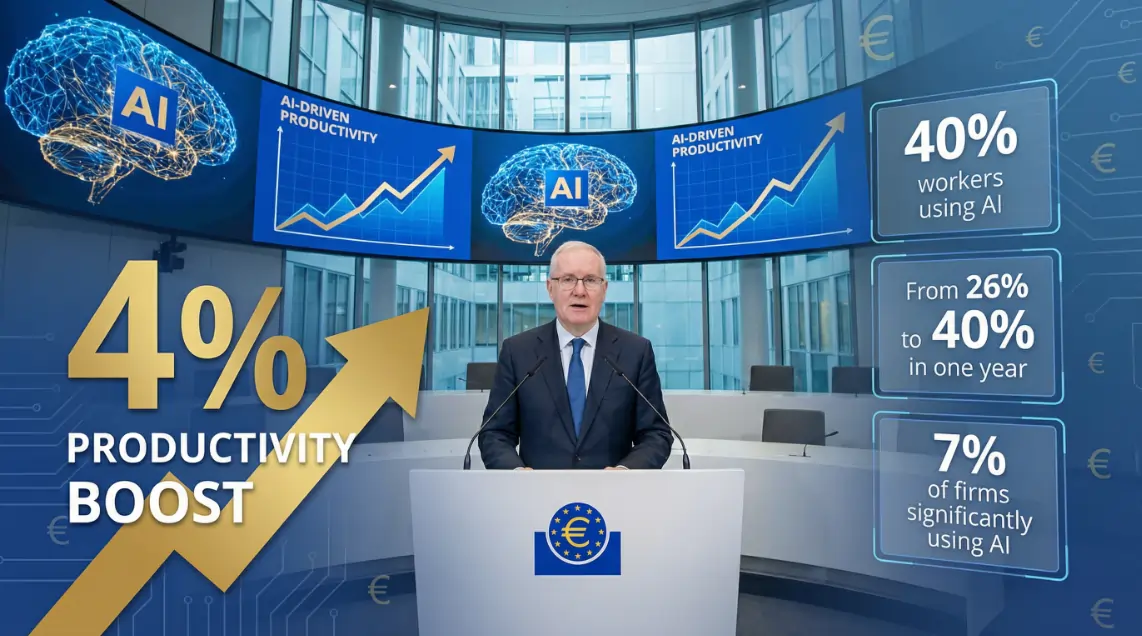
ECB chief economist Philip Lane declared on March 23 that artificial intelligence could raise euro zone productivity growth by more than 4 percentage points over the next ten years. The projection came with a condition that makes it far from guaranteed. Europe must adopt the technology fast enough, and energy prices must not stay elevated.
What Lane Told the Frankfurt Conference
Lane presented a range of scenarios at the ECB-SAFE-RCEA International Conference on the Climate-Macro-Finance Interface in Frankfurt. If AI adoption follows the pattern of earlier technologies such as the internet, Europe would see at least 1.5 percentage points of added productivity growth over a decade. But if adoption holds at its current rapid pace and reaches at least half the economy, the gain could surpass 4 percentage points.economictimes.
“The greatest impact will be achieved if AI materially boosts the pace of innovation, as rather than just boosting the level of productivity, this could increase the long-run potential growth rate,” Lane said.
That distinction matters. A single productivity bump improves living standards. A permanent lift in the growth rate compounds over generations.
Where Lane's Numbers Sit Among Global Forecasts
Lane's projections land at the optimistic end of a wide range. Earlier ECB staff work from March 2025 estimated a more moderate 3.5 percentage points over ten years under moderate assumptions. At the lower bound, MIT economist Daron Acemoglu has argued total productivity gains from AI over a decade are unlikely to exceed 0.66%. Goldman Sachs projected a 7% global GDP increase over ten years, while McKinsey estimated up to 3.4 percentage points of annual productivity growth through 2040. The sheer spread of these estimates reveals how much depends on assumptions about adoption speed and organizational change.
40% of Euro Area Workers Already Use AI
The speed of AI uptake in Europe already outpaces historical precedent. ECB Consumer Expectations Survey data shows the share of euro area employees using AI at work jumped from 26% in 2024 to 40% in 2025. The internet and personal computers each took roughly a decade to hit similar adoption levels.
Workers with university degrees adopt AI at 47%, compared with 28% for those without. Younger employees aged 18 to 34 lead at 52%, while workers 55 to 74 trail at 29%.
Among firms, two thirds of the 5,000 companies surveyed by the ECB reported some employee AI usage. But only 7% of firms use AI in any significant way. The technology remains concentrated in a small core of businesses rather than embedded across corporate processes.
The Digital Investment Gap Keeps Growing
Lane's speech drew a sharp contrast between European and American AI spending. Euro area digital investment stood about 60% higher in 2025 than in 2014. A comparable US measure more than doubled over the same period, propelled by a surge in data center construction. The gap is widening, not closing.
Venture capital paints the same picture. While AI's share of euro area VC deals has climbed, Europe's total risk capital pool remains far smaller than what the US offers. Between 2008 and 2021, nearly 30% of European unicorn startups relocated abroad, overwhelmingly to the United States, citing better financing and simpler regulation.
Mario Draghi's 2024 competitiveness review identified this digital gap as structural. He estimated that roughly 70% of the EU's per capita GDP shortfall relative to the US traces back to lower productivity, mostly in information and communication technology.
High Energy Costs Threaten the AI Buildout
Lane issued a pointed warning about energy. Persistently high fuel costs would slow progress in building new AI models and restrict the rate of adoption, given the technology's intense power requirements. With the ECB monitoring Middle East tensions and their inflation spillovers, this is not a distant risk.
The European Data Centre Association has flagged similar concerns, pointing to insufficient energy supply alongside skilled worker shortages and regulatory burden as barriers to faster AI deployment.
No Mass Layoffs, But Mixed Signals Ahead
An ECB blog post published earlier in March 2026 argued that firms investing in AI across the euro zone tend to hire rather than fire. ECB President Christine Lagarde reinforced this message in late February, saying the bank sees no wave of layoffs driven by AI.
Firm-level evidence presented by Lane aligns with that finding. AI adoption among EU firms has yielded a 4% increase in labor productivity through capital deepening, with no negative employment effects. A European Investment Bank working paper studying more than 12,000 firms in the EU and US reached the same conclusion.
But the picture is not entirely reassuring. Large firms participating in the ECB's Corporate Telephone Survey increasingly cite process optimization powered by AI as a reason behind a “rather lacklustre employment outlook”. About 23% of euro area workers express negative expectations about AI's effect on their jobs, fearing displacement or worsening prospects. The job creation story playing out right now and the displacement risk over the coming years may not tell the same story.
Why This Changes the ECB's Calculus
Lane framed AI as a variable the ECB must actively track. If AI raises potential output, it shifts the neutral interest rate. If adoption speeds diverge across euro area member states, it creates uneven productivity paths that complicate monetary policy for a shared currency.
His policy message was direct. Europe needs broad access to finance, faster technology diffusion among smaller firms, and sustained investment in skills and intangible assets. Without those building blocks, the AI productivity dividend will arrive smaller, later, and more unevenly distributed than the headline 4% figure suggests.
FAQs
How much could AI add to euro zone productivity growth over the next decade?
ECB chief economist Philip Lane estimated that AI could add more than 4 percentage points to euro zone productivity growth over ten years if adoption reaches at least half the economy. A slower adoption rate, in line with past technologies like the internet, would yield at least 1.5 percentage points.
What share of euro area workers currently use AI on the job?
The ECB's Consumer Expectations Survey found that 40% of euro area employees used AI in their work as of 2025, up from 26% in 2024. Adoption is highest among younger, university-educated workers.
Is AI causing job losses in Europe right now?
Not yet, according to multiple ECB analyses. A European Investment Bank study of over 12,000 firms found AI adoption increased labor productivity by 4% through capital deepening with no adverse employment effects. However, some large firms report AI is contributing to weaker hiring plans.
Why is Europe falling behind the US in AI investment?
Euro area digital investment grew about 60% between 2014 and 2025, while a similar US measure more than doubled, largely due to data center spending. Europe's shallower capital markets and smaller venture capital pool limit the ability of startups to scale domestically.
Could high energy prices block Europe's AI ambitions?
Lane warned that persistently elevated fuel costs would slow both the development of new AI models and the pace of adoption across the economy. The European Data Centre Association has also flagged energy supply constraints as a barrier.
What does AI mean for ECB monetary policy?
If AI raises potential output, it affects the neutral interest rate that guides ECB decisions. Uneven adoption speeds across member states could create divergent productivity paths, making shared monetary policy more difficult to calibrate.
Topics
Artificial Intelligence
European Central Bank
Euro Zone Productivity
AI Adoption Europe
ECB Monetary Policy
Digital Investment Gap
AI Employment Impact
European Competitiveness






ECB AI Productivity
Max productivity gain
Over 4 points
Worker adoption 2025
40% of
employees
Significant firm usage
Only 7%
Baseline scenario gain
1.5 points
minimum
Unicorn relocations
30% left Europe
Employment impact
No layoffs yet
✉️ Daily AI Digest
Get the day's most important AI stories in one sharp email. Join 42,800+ readers.
Free forever · No spam
🔥 Trending Now