
Musk Unveils $20B Terafab Chip Factory in Austin
Tesla and SpaceX will jointly build a massive fab targeting 2nm chips for AI, robots, and space.

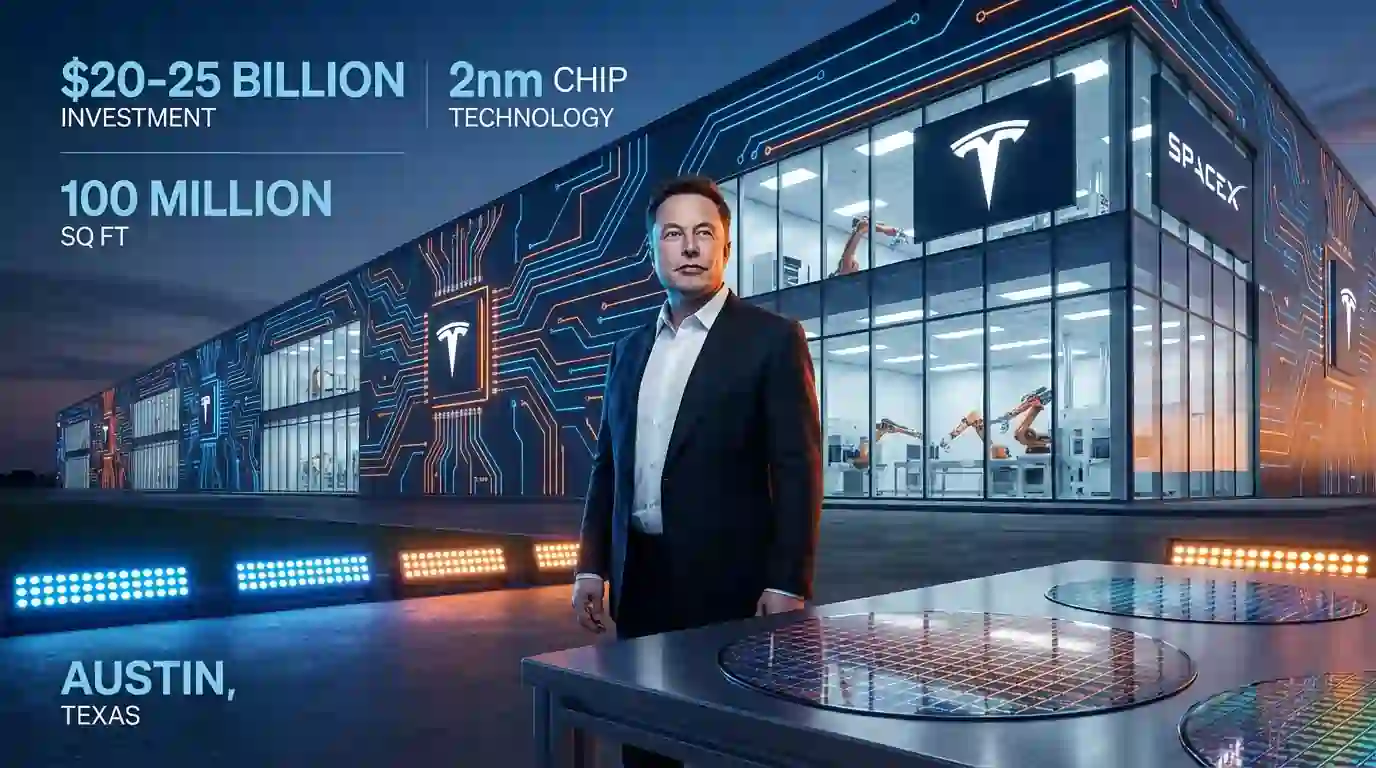
Elon Musk announced Terafab on Saturday night inside Austin's historic Seaholm Power Plant, revealing a plan estimated at $20 billion to $25 billion to build what he called “the most epic chip building exercise in history by far”. The joint Tesla and SpaceX facility will manufacture 2-nanometer chips designed to power everything from autonomous vehicles to humanoid robots to orbital AI infrastructure.
Why Musk Wants to Make His Own Chips?
The motivation is blunt. Musk told attendees that semiconductor manufacturers are not producing chips fast enough for his companies' AI and robotics demands. “We either build the Terafab or we don't have the chips, and we need the chips, so we build the Terafab,” Musk said, per Bloomberg's reporting.
Tesla already relies on two of the world's largest chipmakers. TSMC produces Tesla's current AI5 chip, which supports Full Self-Driving technology. Last July, Tesla signed a $16.5 billion deal with Samsung to manufacture its upcoming AI6 chip at Samsung's Texas fab. But Musk now argues that outsourcing alone will not satisfy his companies' appetite for silicon.
“Either we make Terafab or we will be stuck at the ~20% chip/memory output growth per year of the current industry,” Musk posted on X following the event.
Inside the Terafab Design
The planned complex goes far beyond a traditional chip factory. Musk described two coordinated fabrication lines, each built around a separate chip architecture to simplify production and accelerate iteration cycles. The facility will combine chip design, fabrication, mask production, advanced packaging, and testing all under one roof.
Musk said the research fab could enable new chip versions to be produced daily with less than one week of turnaround time. That kind of speed would allow rapid testing and design improvements at a pace the traditional semiconductor industry has never attempted.
The scale is staggering. Musk indicated the facility would require thousands of acres and more than 10 gigawatts of power at full operation. When a user on X estimated the site could approach roughly 100 million square feet, Musk confirmed the figure was “the right order of magnitude”. The computing target is equally bold, with Musk claiming Terafab would produce chips supporting 100 to 200 gigawatts of computing power annually on Earth and a terawatt in space.
From Dojo's Collapse to Terafab's Rise
Terafab does not exist in a vacuum. In August 2025, Tesla shut down Dojo, its custom AI training supercomputer. Musk called the second generation chip “an evolutionary dead end” after roughly 20 engineers departed to form their own startup called DensityAI.
Then in January 2026, Musk reversed course and announced that Tesla would restart work on Dojo3, this time dedicated to space AI computing rather than training autonomous driving models on Earth. The AI5 chip design had reached a stable stage, giving Musk confidence to push forward. Terafab now appears to be the manufacturing backbone that would produce the chips powering Dojo3 and all future Tesla silicon.
Musk also confirmed that roughly 80% of Terafab's compute output is ultimately intended for orbital AI systems, aligning with SpaceX's plans to launch a fleet of satellites capable of handling AI processing.
Analysts See Historic Ambition and Historic Risk
Patrick Moorhead, chief analyst at Moor Insights & Strategy, called the proposal “the most ambitious semiconductor manufacturing bet in history” on X but noted that several technical foundations required to support the plan remain undisclosed.
Dan Nystedt, vice president of research at TriOrient, observed that Terafab could represent a reversal of decades of semiconductor industry specialization. “Elon's TeraFab will bring logic, memory, advanced packaging, and even lithography/mask-making back under one massive roof in Austin, Texas, a somewhat retro move, but perhaps exactly what's needed now,” Nystedt said.
Bloomberg and multiple analysts pointed out that Musk has no background in semiconductor manufacturing and a widely noted track record of overpromising on goals and timelines. He did not provide any timeline for when Terafab would become operational. Tesla stock slipped in overnight trading following the announcement.
Elon Musk finally announced the most ambitious manufacturing project since the Manhattan Project.
— Rohan Paul (@rohanpaul_ai) March 22, 2026
A $20B Austin chip fab meant to supply the AI hardware for Tesla, SpaceX, and xAI at enormous scale.
80% of chips go to space for giant solar-powered AI data centers (launched by… pic.twitter.com/TxuNwuzWQK
The Biggest Gamble in Chip History
If executed, Terafab would make Tesla and SpaceX the only companies outside of TSMC, Samsung, and Intel capable of producing advanced logic chips at scale. The facility's 2-nanometer target places it at the absolute frontier of semiconductor technology, matching what TSMC and Samsung are currently racing to deliver.
Musk has taken on supply chain challenges before with mixed results. Tesla's Gigafactory proved that vertical integration of battery manufacturing could work at scale. Whether that logic extends to the infinitely more complex world of semiconductor fabrication is a question that $20 billion or more will eventually answer.
FAQs
What is Terafab?
Terafab is a planned semiconductor fabrication facility in Austin, Texas, jointly operated by Tesla and SpaceX. It aims to produce advanced 2-nanometer chips for AI, robotics, autonomous vehicles, and orbital computing. Musk announced the project on March 22, 2026, with estimated costs between $20 billion and $25 billion.
Why is Musk building his own chip factory?
Musk says the global semiconductor industry cannot produce chips fast enough for Tesla and SpaceX. He argued that relying on external foundries like TSMC and Samsung limits his companies to roughly 20% annual growth in chip and memory output. Terafab is designed to remove that bottleneck entirely.
What chips will Terafab produce?
The facility targets 2-nanometer chips for Tesla's Full Self-Driving system, Optimus humanoid robots, and SpaceX's satellite AI infrastructure. It will also support future iterations of Tesla's AI chip roadmap, including the AI6 and AI7 generations.
How big will Terafab be?
Musk said the facility would span thousands of acres and require more than 10 gigawatts of power at full scale. He confirmed that estimates of roughly 100 million square feet were “the right order of magnitude,” making it potentially the largest chip manufacturing complex on Earth.
When will Terafab be operational?
Musk did not provide an official timeline . Some reports suggest initial production could begin in 2027, though analysts caution that Musk has a long history of missing stated deadlines on major projects.
Does Tesla still work with TSMC and Samsung?
Yes. TSMC is currently manufacturing Tesla's AI5 chip, and Samsung holds a $16.5 billion contract to produce the AI6 chip. Terafab is designed to reduce but not immediately eliminate Tesla's dependence on external foundries.
Sources
Topics
Terafab
Tesla AI Chips
SpaceX
Semiconductor Manufacturing
Elon Musk
Austin Texas
2nm Chip Fabrication
Vertical Integration






Terafab at a Glance
Estimated Investment
$20B to $25B
Location
Austin, Texas
Chip Target
2-nanometer
process
Joint Operators
Tesla and SpaceX
Annual Earth
Compute
100 to 200 GW
Space Compute
Goal
One terawatt
✉️ Daily AI Digest
Get the day's most important AI stories in one sharp email. Join 42,800+ readers.
Free forever · No spam
🔥 Trending Now